Deployment
We place a calibrated continuous radon monitor in the lowest livable level, away from drafts, humidity, and direct airflow — positioned for a true reading.

Western Pennsylvania sits in one of the highest radon risk zones in the country. Our continuous-monitor test gives you a documented, defensible reading — not a guess.
Section 01 / The hazard
Radon is a naturally radioactive gas released by the decay of uranium in soil and rock. It seeps unseen through foundation cracks, sump pits, and well casings — concentrating in the basements Pennsylvania homes are built around.
Long-term exposure is the leading cause of lung cancer among non-smokers. You can't smell, see, or taste it. The only way to know your level is to test. Our continuous monitor records radon levels throughout the testing period, providing a documented result and hourly readings.
Section 02 / Protocol
We place a calibrated continuous radon monitor in the lowest livable level, away from drafts, humidity, and direct airflow — positioned for a true reading.
The monitor records radon concentrations hourly throughout the testing period.
We retrieve the monitor, download the hourly curve, and deliver a documented report with the average, peaks, and a clear recommendation.
Section 03 / Entry pathways
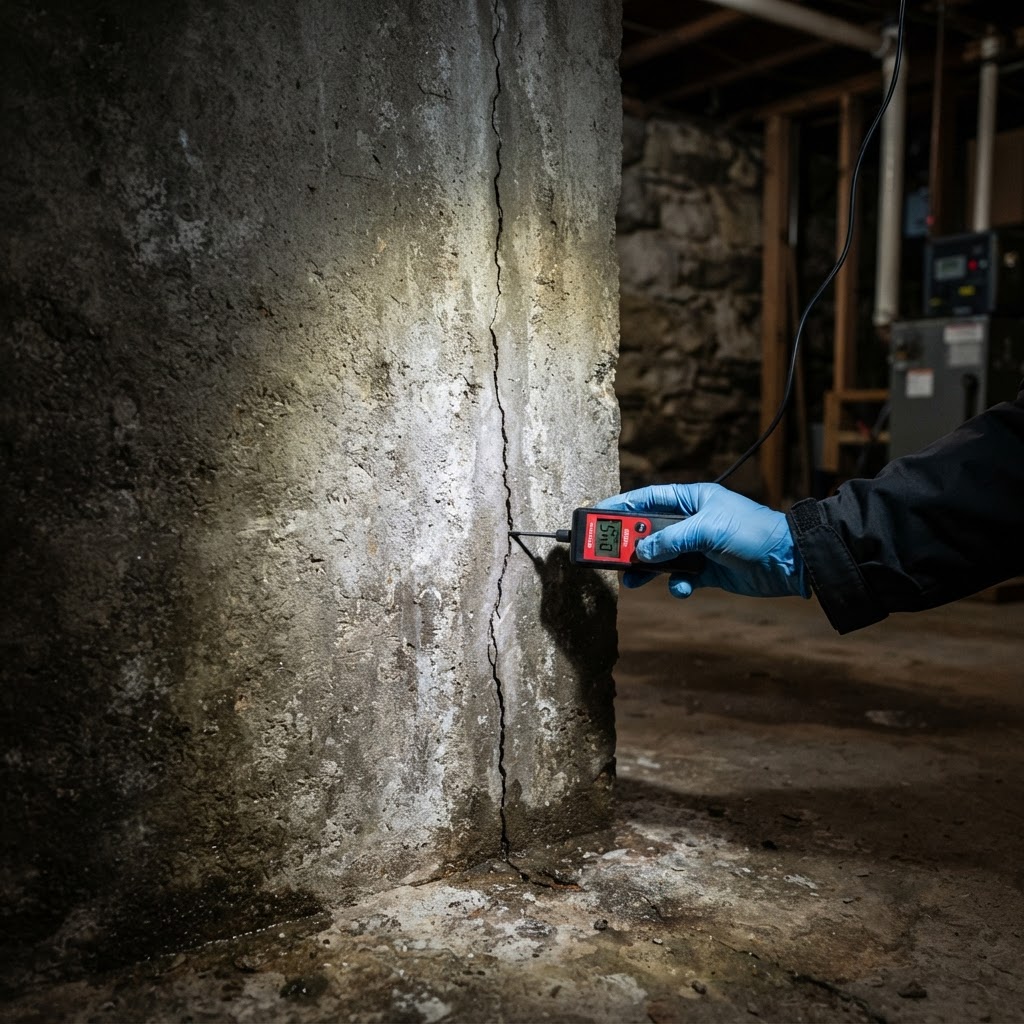
Radon may enter through foundation cracks, construction joints, openings around utility penetrations, sump areas, crawl spaces, and other pathways between the building and the soil.
A radon measurement evaluates the indoor air. The reading—not the visible condition of any single crack or opening—determines whether further action should be considered.
Section 04 / Reading the result
Radon is measured in picocuries per liter (pCi/L). The EPA action level is 4.0 — but no level is truly “safe.” The measurement reflects the testing period. Elevated results come with guidance on appropriate follow-up testing or mitigation.
Section 05 / Schedule Your Test
Standalone testing available—call for pricing.